- Agentic AI
- Solo project: hardware, firmware, backend, agents
- Oct 2026
Macchinina
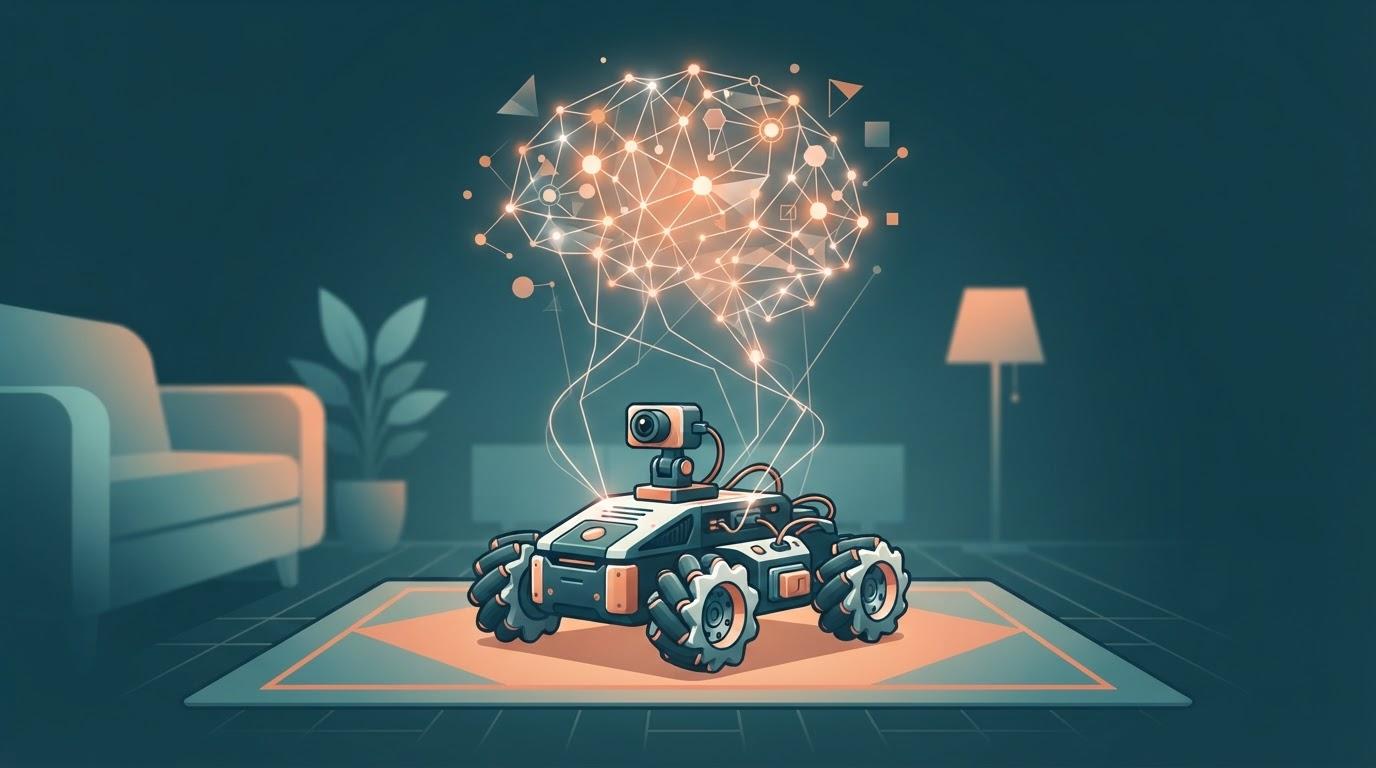
A Raspberry Pi robot that I can drive from the web or that Claude can pilot through MCP, with safety reflexes kept on the robot.
- Python
- MQTT
- Mosquitto
- Docker Compose
- Flask
- MCP
- YOLO11n
- DINOv2
- OWLv2
- Whisper
- systemd
The problem
I wanted to give an AI agent a physical body. The goal was a robot I could drive by hand from a web page, that an LLM (Claude Code) could also pilot, and that had a little home autonomy: knowing which room it is in and moving towards objects I name aloud. It is a personal experiment, with no client.
What I built
Two halves talking over MQTT: a Mac running Docker Compose (broker, brain, Flask web controller with video and two-way audio) and a Raspberry Pi 5 running systemd services.
Perception on the Pi: YOLO11n object detection about once per second, room recognition with DINOv2 embeddings and k-NN over reference photos, ultrasonic distance and a WiFi signal fingerprint as an extra signal.
A reproducible mirror of the Pi setup in the repo (deploy, provisioning and check scripts), and tests that run against a fake robot, never real motors.
How the agent works
Claude connects through an MCP server that exposes tools to drive, follow a short path, approach a named object, stop, look through the camera, read perception, listen and speak. Each tool has hard limits enforced on the Pi and returns a structured outcome (arrived, lost, not found, blocked, timeout, operator). For named objects, a resident process on the Mac runs OWLv2 for open-vocabulary detection and steers the robot in a closed loop.
Guardrails live on the robot, not in the model:
A command whitelist on the Pi, so LLM output is never forwarded raw.
Every AI command is valid for under a second and must be renewed at about 10 Hz, so if the Mac or the network drops the robot stops by itself. A watchdog and an obstacle stop under 20 cm back this up.
Human in the loop: the operator always has priority over the agent, and autonomy (off, dry run, on) is never active at startup and expires without a heartbeat from the UI.
Interesting decisions
Split by latency: deterministic reflexes and motor control on the Pi, slow deliberation on the Mac.
Stop-and-go driving: the camera blurs while moving, so the pilot looks while stopped, makes one move, then looks again.
Camera and microphone are off by default and switched on with a keepalive.
What I would do differently today
I first tried a small local LLM, zero-shot, to decide the robot's moves. I measured it on 72 scenarios: 12% correct when given numeric state and 32% when the state was described in words, against 20% for random choice. That is worse than chance in the first case, so I discarded it and replaced it with a rule-based decider behind the same interface.
Today I would run that kind of comparison against chance before building around a model, and keep the LLM for deliberation through tools, where limits and outcomes are explicit.
Need something similar?
Tell me about your project: I usually reply within one working day.
Get in touch